

Let’s be honest.
Shipping code has never been easier.
Ten years ago, launching a web app took a team of engineers and months of infrastructure setup. Today? You can spin up a Next.js and Supabase project in a single weekend. You can wire up a Python backend, plug in an AI API, and have a working MVP before Monday morning.
But there’s a massive problem.
While building has become a breeze, getting people to actually use what you built has become harder than ever.
The internet is wildly noisy. You can’t just launch on Product Hunt, tweet about it twice, and expect a flood of paying users.
If you are a solo developer—a “vibe coder” who leverages AI and modern frameworks to build at the speed of light—you need a completely different playbook for marketing.
You need to stop acting like a traditional marketer.
And start treating user acquisition like an engineering problem.
In this definitive guide, I’m going to show you exactly how to get your first 100 to 1,000 users. Not by grinding on social media. But by building scalable, automated marketing engines that work while you sleep.
Ready? Let’s dive right in.
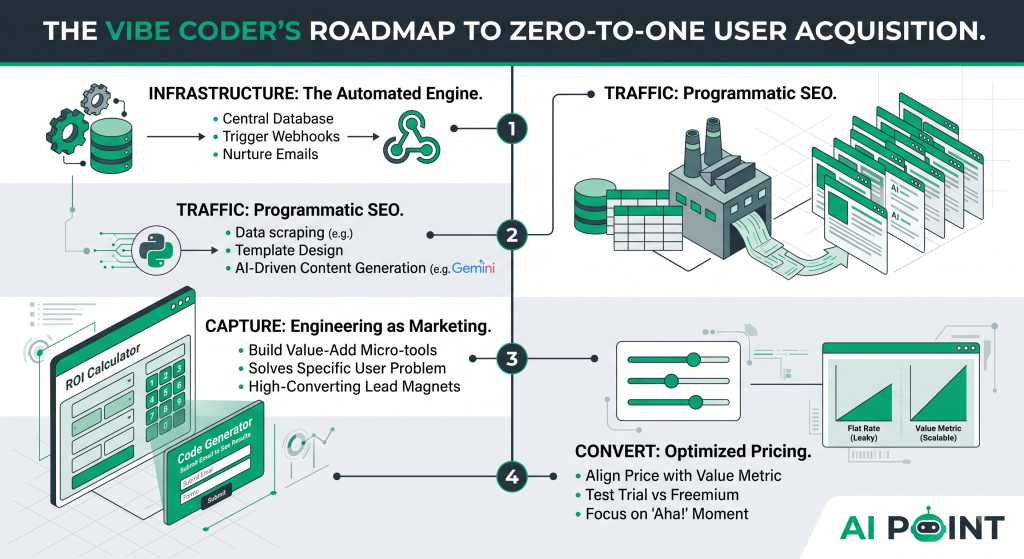
Phase 1: Setting Up the Solo Marketing Engine
Most developers make the exact same mistake.
They launch their app, and then they start scattering their energy. They write a random blog post. They spam links in Reddit comments. They send a few cold emails.
The result? Crickets.
Why? Because they are driving traffic to a leaky bucket. They have no system to capture attention, nurture leads, or measure what’s actually working.
Before you write a single line of marketing copy, you need to build your infrastructure.
The Problem With “Frankenstein” Marketing
When you are a solo dev, time is your most valuable asset. You cannot afford to spend three hours a day logging into Google Analytics, checking Mailchimp, and manually exporting CSV files from your database.
You need a lightweight, fully automated system.
The “Vibe Coder” Stack
Instead of buying bloated enterprise software, use the tools you already know how to code with.
Here is the exact setup you should build:
1. The Central Database (Supabase/Prisma) Your application database shouldn’t just hold user passwords. It needs to be the central brain of your marketing. Every time someone signs up, runs a free search, or interacts with a widget, that event needs to be logged.
2. The Webhook Highway Stop doing things manually. Write a simple serverless function that listens for database changes. When a new user hits your Next.js frontend and creates an account, fire a webhook.
3. The Email Engine Catch that webhook and dump the user straight into an automated email sequence.
When you connect these three pieces, you create an invisible machine. You drive traffic to the site, the site captures the lead, and the automated emails do the selling. You never have to lift a finger.
Setting up a lean, automated multi-channel marketing stack for a solo vibe coder lets you punch above your weight class without spending all day managing dashboards.
Bottom line: Do not write a single blog post or launch a single ad until your capture-and-nurture system is hardcoded and tested.
Phase 2: Generating Top-of-Funnel Traffic at Scale
So, your infrastructure is set up.
Now you need eyeballs.
Traditional content marketing tells you to write one “high-quality” blog post a week.
Look, writing a multi-spoke pillar content strategy is great for building authority on a flagship tech blog like AI Point. But if you need to drive massive product adoption fast, artisanal blogging won’t move the needle quickly enough for a new SaaS.
You need to leverage your unfair advantage: code.
Enter Programmatic SEO (pSEO)
Programmatic SEO is the art of treating content creation like a database query.
Instead of writing one article targeting “Best SEO tools,” you create a system that generates 1,000 pages targeting long-tail keywords like:
-
“Website builders for plumbers in Chicago”
-
“Website builders for roofers in London”
-
“Website builders for dentists in Toronto”
These keywords have low search volume individually. But in aggregate? They bring in massive, highly-targeted traffic. And because the competition is low, you can rank on page one almost instantly.
The 3-Step Programmatic Playbook
Step 1: Build the Database Let’s say your goal is to find B2B clients who need websites built. You want to target businesses in the United States, Canada, and the United Kingdom that currently lack an online presence.
Instead of Googling them one by one, you write a Python script.
You hit the Google Maps API. You scrape data for local businesses across hundreds of cities. You filter out the ones that already have a website URL listed.
Boom. You now have a database of 10,000 highly qualified prospects and localized data points.
Step 2: Design the Template Next, you build a dynamic route in your Next.js application (e.g., /websites-for-[niche]-in-[city]).
You design this page once. You make it look incredible. You add conversion-optimized buttons and fast-loading CSS.
Step 3: Inject the Data with AI This is where the magic happens.
You pass your database rows through an AI model like Gemini. You prompt the AI to generate unique, localized copy for every single page based on the city and the niche.
You aren’t just swapping out the city name (Google hates that). You are generating genuinely helpful, context-rich content for every single URL.
If you want the exact playbook on generating the content, read our deep dive on using programmatic SEO and AI to spin up 1,000 hyper-local landing pages.
When you deploy this, Google indexes thousands of pages. Suddenly, you aren’t fighting for one massive keyword. You are casting a net across the entire internet.
Phase 3: Capturing Leads with “Engineering as Marketing”
Traffic is great.
But traffic doesn’t pay the server bills.
You need to convert those visitors into leads. And let me tell you a harsh truth about the B2B world in 2026:
The traditional “Download Our Free PDF eBook” lead magnet is completely dead.
Nobody wants another 15-page PDF cluttering up their downloads folder. Developers hate them. B2B buyers ignore them. If you put a form in front of a PDF, your bounce rate will skyrocket.
So, what do you do instead?
Engineering as Marketing
You build things.
You take a small, highly valuable piece of your core product, and you give it away for free on a landing page. But here is the catch: to get the result, the user has to give you their email address.
We call these “micro-tools.”
Why Micro-Tools Crush PDFs Every Time
When someone searches for a solution, they want an immediate answer.
If they are trying to figure out their server costs, they don’t want to read an eBook about cloud computing. They want an interactive calculator.
As a vibe coder, this is your ultimate weapon. Why? Because marketing agencies have to charge a client $10,000 to build a custom interactive tool. You can build it in HTML, CSS, and vanilla JavaScript in two hours.
Examples of High-Converting Micro-Tools
-
The ROI Calculator: Let users input their current metrics (e.g., ad spend, conversion rate). Write a quick script that calculates how much money they are losing by not using your product. Gate the detailed PDF report behind an email form.
-
The Free Generator: Need to generate metadata? Need a specific unicode text character for a verification badge (not an image, but a perfectly formatted text string)? Build a tool that does exactly that. One click, instant value.
-
The Audit Tool: Let users paste their website URL. Run a quick Python script in the background to scrape their site for errors, and email them the results.
The Psychology of the Micro-Tool
It works because of the “Sunk Cost Fallacy.”
The user spends 60 seconds inputting their data, playing with the sliders, and engaging with the tool. They have already invested time. When the tool finally asks for an email to “Send my custom results,” the conversion rate is astronomically high.
Learn exactly how to architect these assets to capture emails in our guide to driving B2B inbound leads with AI-generated calculators and micro-tools.
Stop writing boring whitepapers. Start coding tiny, addictive tools.
Phase 4: Monetization and the Psychology of Pricing
Congratulations.
You have built the automated engine. You have thousands of programmatic pages driving traffic. You have micro-tools capturing emails.
People are using your app.
But there’s one final boss to defeat: Getting them to pull out their credit cards.
This is where technical founders usually drop the ball. They build a brilliant product, but they price it completely wrong. They use complex feature matrices that confuse the buyer, or worse, they underprice their tool out of fear.
The Value Metric Concept
How do you charge?
Do not charge a flat monthly fee just because everyone else does. Charge based on a “Value Metric.”
A value metric is the exact unit of value your customer gets from your product.
-
If you sell an email tool, the value metric is “emails sent.”
-
If you sell an AI video generator, the value metric is “minutes of video rendered.”
-
If you sell a database API, the value metric is “API calls.”
When you align your pricing with the exact moment the user says “Aha! This is valuable!”, your conversion rates will explode. If they only use a little, they pay a little. If they use your tool to make thousands of dollars, they happily pay you hundreds.
Freemium vs. Free Trial
For solo-built AI tools, this is the eternal debate.
Here is the rule of thumb:
If your product is highly viral and easy to understand (like a tool to optimize YouTube Shorts or TikTok videos), use Freemium. Let them use a watermarked version forever. Their usage becomes your marketing.
If your product is a heavy B2B SaaS that solves a complex workflow, use a 14-Day Free Trial. Force them to make a buying decision while they are highly engaged.
The MVP Payment Hack
When you are first launching your Zero-to-One SaaS, you might be tempted to spend three weeks building out a massive, multi-tiered automated Stripe integration with user billing portals and API gateways.
Stop.
Do not over-engineer your first checkout flow.
If you are launching a new community, a fundraising project, or a premium coding class, do things that don’t scale. Process your payment updates manually.
Tell the user: “Pay via this simple checkout link, and I will manually upgrade your account within 12 hours.”
Is it clunky? Yes. But it takes 5 minutes to set up. It validates whether people will actually pay for your product before you spend a month writing backend billing code. Once you have 10 paying users, then you write the automation.
To figure out the exact tiers and psychology for your checkout page, check out our framework on how to price and package an AI-built SaaS product for maximum conversion.
Conclusion: The Vibe Coder’s Manifesto
Let’s recap the journey.
You didn’t get your first 1,000 users by begging for upvotes on Hacker News.
You did it by engineering a system:
-
You built an automated, silent machine to capture leads.
-
You unleashed programmatic SEO to generate thousands of hyper-local landing pages.
-
You coded interactive micro-tools to capture high-intent B2B emails.
-
You aligned your pricing with your user’s exact value metric, testing it manually first to ensure product-market fit.
This is the Vibe Coder’s true advantage.
The best marketing strategy for a developer isn’t to become a marketer. It is to simply do what you do best: build things. But from now on, you build things specifically designed to act as distribution channels.
You are no longer just writing code. You are architecting leverage.
Now, fire up your terminal, open your editor, and go build your engine.
